7950X3D vs EPYC 9454P: fast cores or many cores
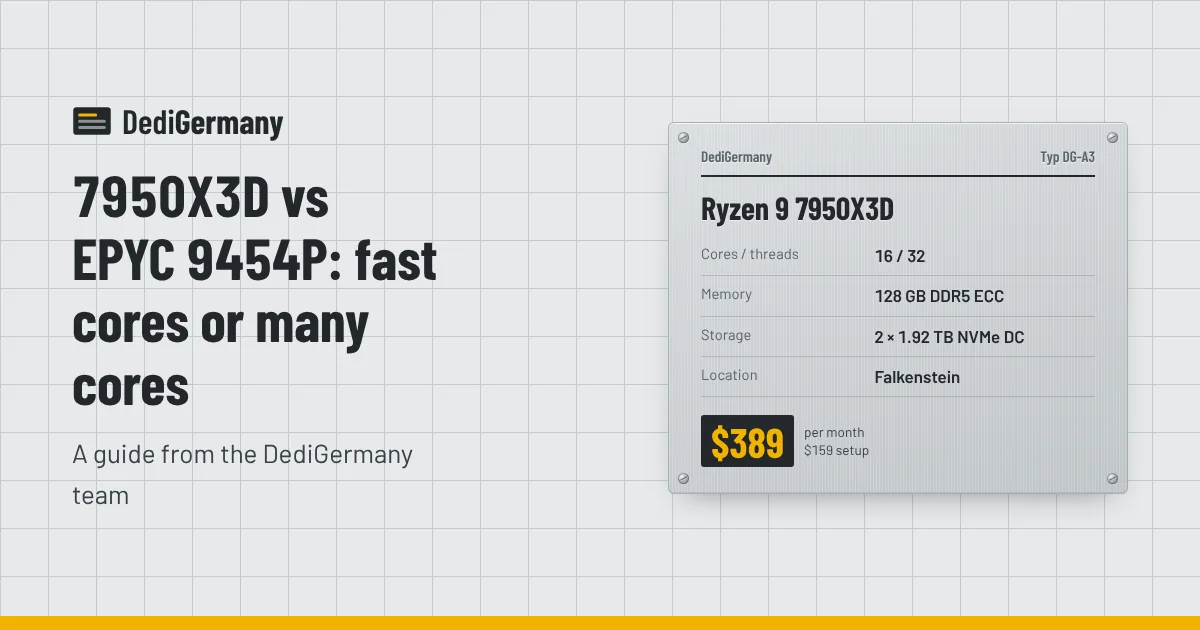
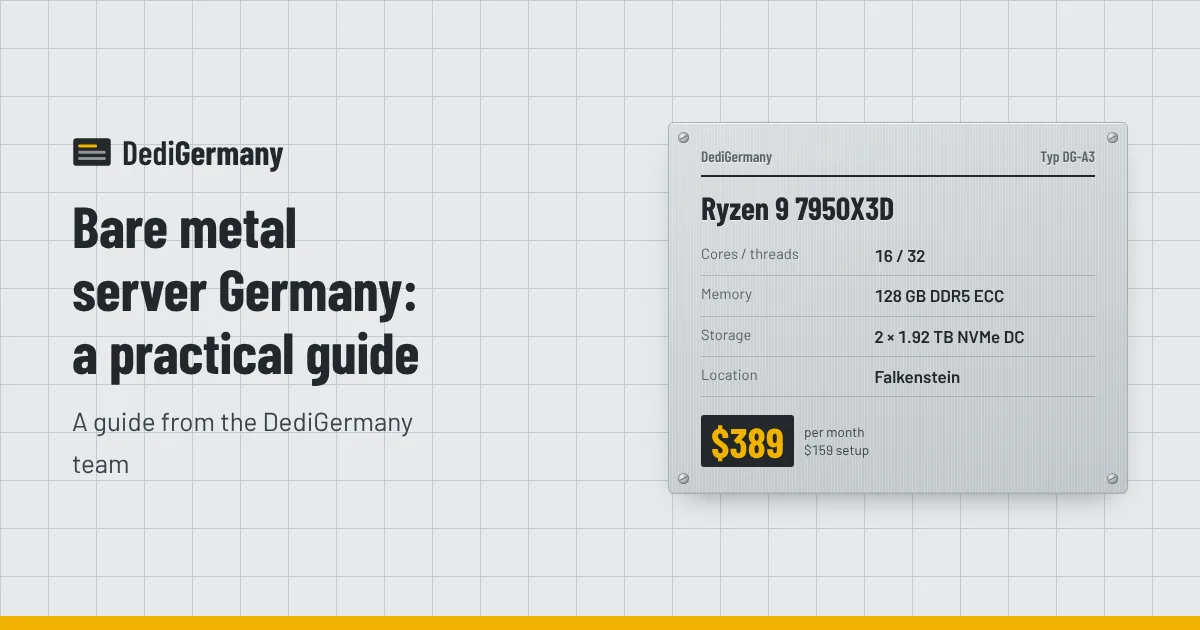
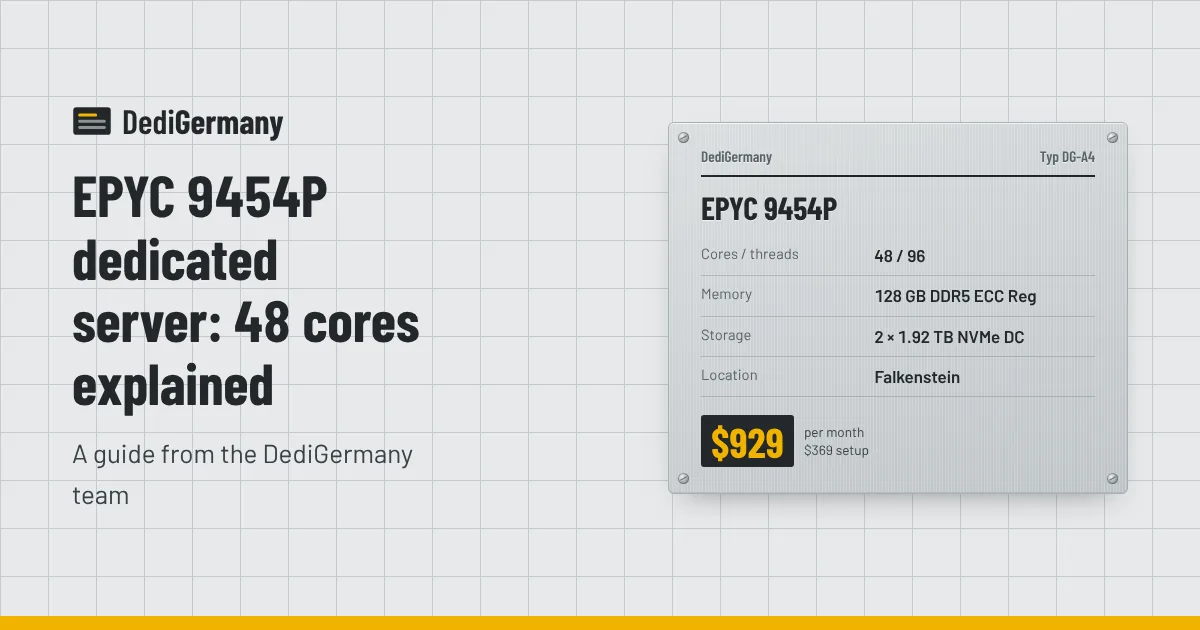
The 7950X3D vs EPYC 9454P choice is really fast cores against many cores. The Ryzen 9 7950X3D gives you 16 cores that boost to 5.7 GHz plus AMD's 3D V-Cache, which makes it excellent for game servers and latency-sensitive databases. The EPYC 9454P gives you 48 cores, a server memory platform and room for up to 512 GB of RAM, which makes it the better virtualisation host and throughput machine. This article compares the two on specs, workloads and price per core using our current prices.
7950X3D vs EPYC 9454P: the specs side by side
| Spec | Ryzen 9 7950X3D | EPYC 9454P |
|---|---|---|
| Cores / threads | 16c/32t | 48c/96t |
| Max boost | 5.7 GHz | 3.8 GHz |
| Memory | 128 GB DDR5 ECC | 128 GB DDR5 ECC Reg (up to 512 GB) |
| Storage | 2 × 1.92 TB NVMe DC (up to 2 × 7.68 TB) | 2 × 1.92 TB NVMe DC (up to 2 × 15.36 TB) |
| Location | Falkenstein | Falkenstein |
| Price | $389/mo | $929/mo |
| Setup fee | $159 | $369 |
Both run AMD's Zen 4 architecture, so the work each core does per clock is similar. The difference is in how many cores there are, how fast they run and what the platform around them supports. Both include an unmetered 1 Gbit/s port, DDoS protection, one IPv4 address with a /64 IPv6 block and full root access.
Fast cores: where the 7950X3D wins
The Ryzen 9 7950X3D is a desktop-class chip with very high clock speeds. One of its two core complexes carries 3D V-Cache, an extra layer of L3 cache stacked on top of the die. Software that repeatedly touches a working set slightly larger than normal cache, such as game simulations and database indexes, spends less time waiting on main memory.
Workloads that favour it:
- Game servers. Minecraft, Rust, ARK and FiveM servers run their main simulation loop largely on one thread. Clock speed and cache decide how many players and entities a server can handle. Our game server hosting guide covers sizing per title.
- Single-instance databases where query latency matters and the dataset fits in 128 GB of memory.
- Web applications with request handling that is mostly single-threaded per request, such as PHP or Node.js.
- Build and compile jobs of moderate size, where high clocks shorten each step.
For a deeper look, see our Ryzen 9 7950X3D dedicated server article.
Many cores: where the EPYC 9454P wins
The EPYC 9454P is a Genoa server processor. Its cores run at lower clocks, but there are three times as many of them, and the platform supports 12 memory channels compared with two on the Ryzen. That means much more memory capacity and bandwidth to feed all those cores.
Workloads that favour it:
- Virtualisation hosts. 96 threads and up to 512 GB of memory let you run many VMs without overcommitting. See our Proxmox virtualisation server page.
- Container platforms and CI farms running many jobs in parallel.
- Large databases whose working set is bigger than 128 GB, or analytical queries that scan in parallel.
- Video transcoding, rendering and batch processing that spread across every available thread.
- Hosting resellers packing many customer accounts onto one node.
The 48-core count also means you can run several busy services on one machine without them competing for cores. A database, a set of application containers and a monitoring stack can each get their own block of cores, and you can pin VMs to specific cores so one noisy workload does not slow the others.
The trade-off is per-core speed. A single request or a single game tick runs slower on a 3.8 GHz core than on a 5.7 GHz one, so software that cannot spread its work across threads will not benefit from the extra cores.
Memory capacity: 128 GB vs up to 512 GB
Memory is often the real deciding factor. The 7950X3D server comes with 128 GB of DDR5 ECC, which is plenty for game servers, web stacks and many databases. The EPYC 9454P starts at the same 128 GB, but it is registered ECC memory on a server platform and can be raised to 512 GB.
If you expect your VMs, caches or database buffers to grow beyond 128 GB, start on EPYC. Moving later means migrating to a new server, while adding memory to an EPYC is an upgrade we can quote on request. Both servers use ECC memory, which corrects single-bit errors before they turn into crashes or silent data corruption. Our post on ECC vs non-ECC memory explains when that matters.
Price per core and total cost
Here is how the two compare using our prices:
| Ryzen 9 7950X3D | EPYC 9454P | |
|---|---|---|
| Monthly price | $389 | $929 |
| Price per core | about $24.31 | about $19.35 |
| Price per thread | about $12.16 | about $9.68 |
| Price per GB of included memory | about $3.04 | about $7.26 |
| First year incl. setup | $4,827 | $11,517 |
The EPYC is cheaper per core, so for thread-bound work it is the better buy. The 7950X3D is far cheaper per gigabyte of memory and costs less than half as much overall. Three 7950X3D servers give you the same 48 cores for $1,167 a month, with faster cores and 384 GB of memory in total, but split across three machines. That works well for game servers or a sharded application, and poorly for one large VM host or a single database that needs all the memory in one place.
Standard or Dell EPYC 9454P
If you choose EPYC, we also offer the Dell EPYC 9454P in our Nuremberg datacenter for $1,089 a month with a $439 setup fee. It adds iDRAC Enterprise remote management, hot-swap drives and redundant titanium power supplies, and takes up to four 7.68 TB NVMe drives. It is the better choice for production hosts where downtime is expensive.
Which one to choose
Start by checking how your current workload uses the CPU. On Linux, htop shows whether one or two cores sit at 100% while the rest idle (a sign you need faster cores) or whether load is spread evenly across all of them (a sign you need more cores). Then check memory use against the 128 GB limit, leaving room for growth.
- Pick the Ryzen 9 7950X3D for game servers, latency-sensitive databases under 128 GB and web applications, or whenever the budget is under $400 a month.
- Pick the EPYC 9454P for virtualisation, containers, CI, large databases and anything that needs more than 128 GB of memory in one machine.
Both are on our AMD dedicated servers page with current availability, billed monthly with no minimum term.