AMD vs Intel dedicated servers in 2026
For years the choice between AMD and Intel servers was easy. It isn't any more: both now ship strong chips at every price point. Here's how the CPUs in our line-up compare and which jobs suit each.
Entry level: Ryzen 5 3600 vs Core i5-13500
The Ryzen 5 3600 is an older Zen 2 design with six cores. The Core i5-13500 is newer, with six performance cores and eight efficiency cores. For a small price difference the Intel chip is noticeably faster in both single-thread and multi-thread work. Choose the Ryzen only if you want the lowest possible monthly bill.
Mid range: Ryzen 7 PRO 8700GE vs Core Ultra 7 265
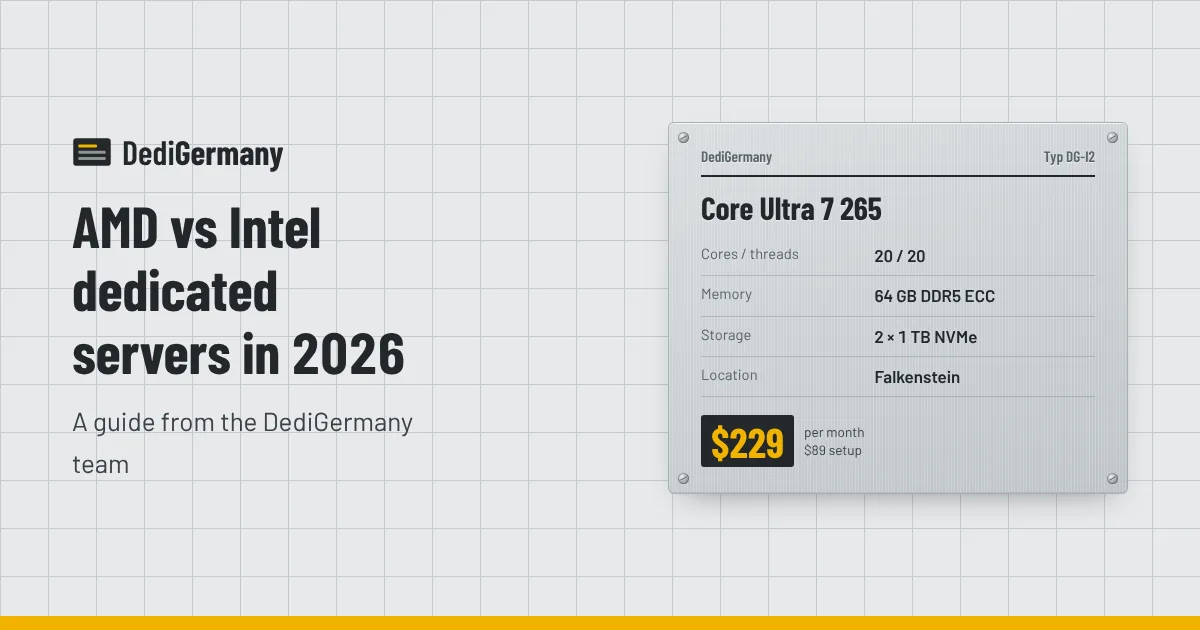
Both use DDR5 ECC memory. The Ryzen 7 PRO has eight Zen 4 cores with simultaneous multithreading and is very efficient. The Core Ultra 7 265 has twenty physical cores without hyper-threading, more starting storage and expands to 192 GB of memory. If you expect to grow in place, the Intel box gives you more headroom.
High end: Ryzen 9 7950X3D
The 7950X3D carries 128 MB of L3 cache thanks to AMD's 3D V-Cache. Workloads that repeatedly touch the same data, such as databases, game simulation and analytics queries, run remarkably well on it. It's the plan we recommend most often for database servers.
Server platforms: Xeon Gold 6731P vs EPYC 9454P
These are true server CPUs with registered ECC memory and many more memory channels. The Xeon Gold 6731P offers 32 cores and supports up to four NVMe drives. The EPYC 9454P offers 48 cores and scales to 512 GB of memory. For virtualisation density, EPYC usually wins. For Windows workloads licensed per core, the Xeon's lower core count can reduce licence costs.
Summary
- Fastest single thread: Ryzen 9 7950X3D
- Most threads per dollar: Core i5-13500
- Best mid-range expansion: Core Ultra 7 265
- Most cores and memory: EPYC 9454P
Compare every plan side by side on the dedicated servers page.