Game server hosting in Germany: a setup guide
For game server hosting in Germany, the CPU's single-thread speed matters more than anything else, followed by enough RAM for each instance and a network that soaks up attacks. This guide explains how Minecraft, CS2 and Rust use hardware, how to size a dedicated server for one big community or dozens of small ones, and how to run them all with Pterodactyl.
Why game servers care about single-thread speed
Most game servers run their main simulation loop on one thread. Minecraft Java processes each world tick largely on a single core, Rust's server simulation is similar, and CS2 runs each match as its own server process whose performance depends heavily on single-core speed. Extra cores let you run more instances side by side, but they do not make one busy server faster. When a tick takes longer than its time budget, players feel it as rubber-banding, delayed block breaks or hit registration problems.
That is why a desktop-class CPU with a high boost clock often beats a much larger server CPU for this job. Look at boost frequency and CPU generation first, then core count, then cache.
Picking a server for game server hosting in Germany
Our German line-up covers every stage, from a first community server to a host running dozens of instances. These are the plans we point game hosts at most often:
| Plan | CPU | Boost | RAM | Storage | Price |
|---|---|---|---|---|---|
| Ryzen 5 3600 | 6c/12t | 4.2 GHz | 64 GB DDR4 | 2 × 512 GB NVMe | $89/mo, no setup fee |
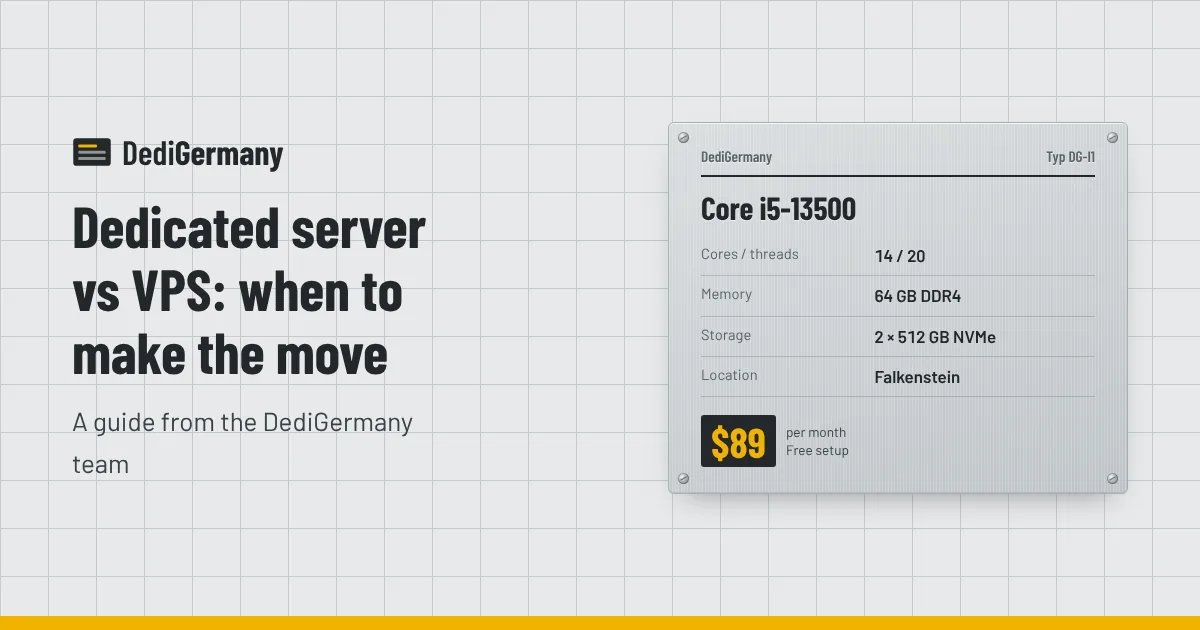
| Core i5-13500 | 14c/20t | 4.8 GHz | 64 GB DDR4 | 2 × 512 GB NVMe | $89/mo, no setup fee |
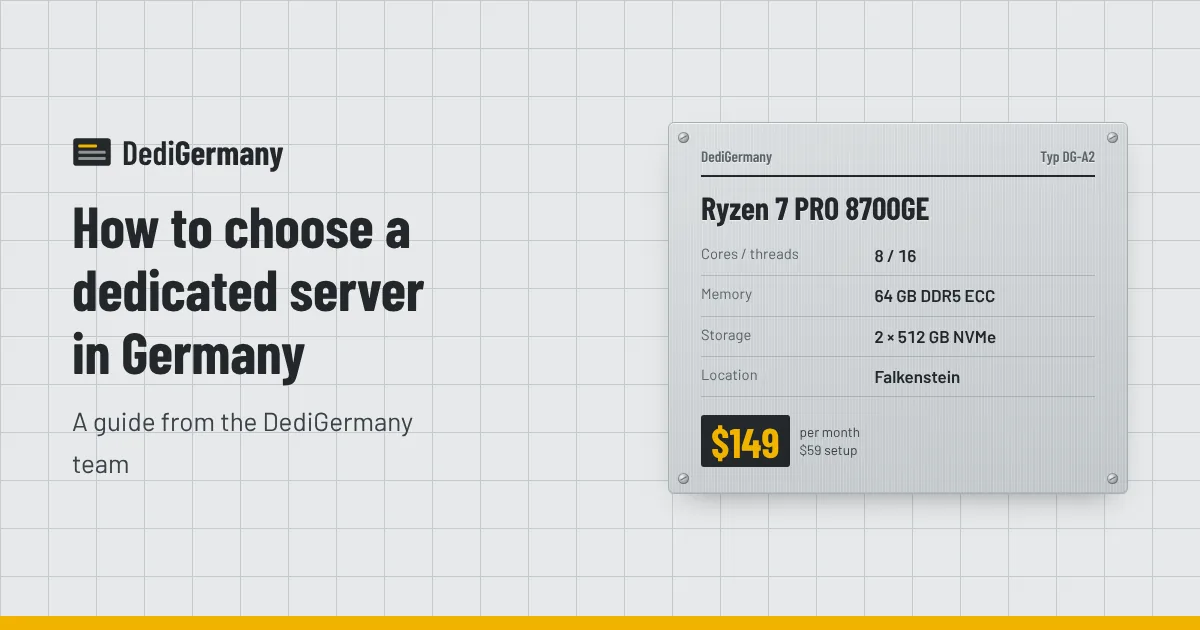
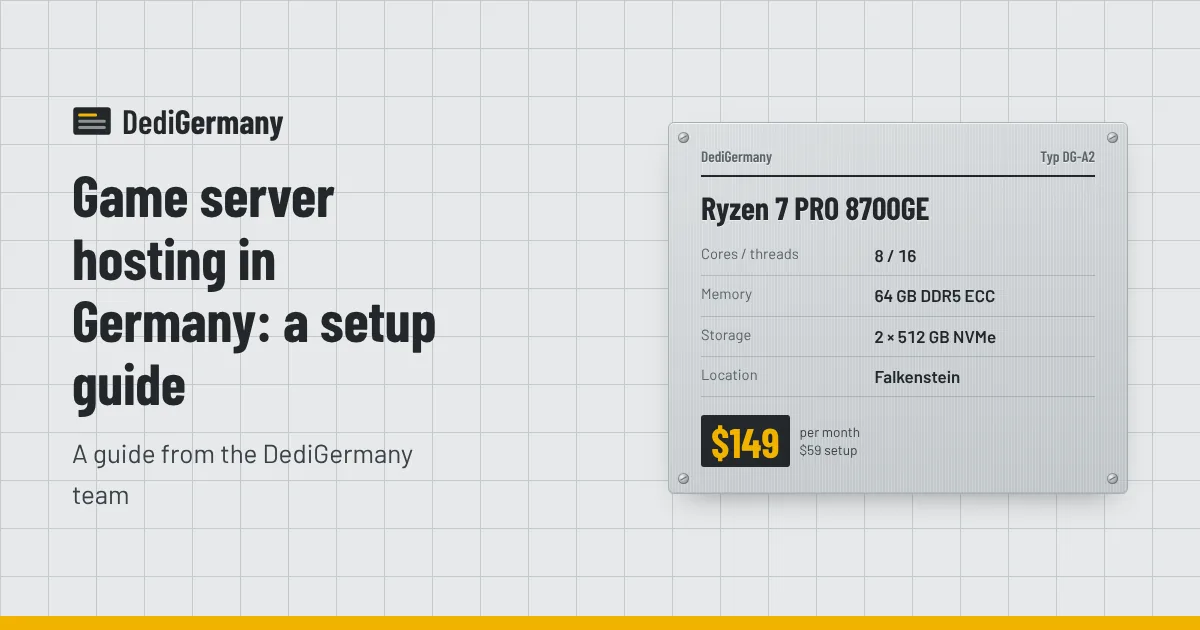
| Ryzen 7 PRO 8700GE | 8c/16t | 5.1 GHz | 64 GB DDR5 ECC | 2 × 512 GB NVMe | $149/mo + $59 setup |
| Ryzen 9 7950X3D | 16c/32t | 5.7 GHz | 128 GB DDR5 ECC | 2 × 1.92 TB NVMe DC | $389/mo + $159 setup |
- Starting out: the Core i5-13500 gives you six fast performance cores plus eight efficiency cores for background work at $89/mo. It suits a handful of Minecraft servers, a few CS2 instances, or one moderate Rust server.
- Serious single community: the Ryzen 7 PRO 8700GE has a 5.1 GHz boost, DDR5 and ECC memory, so a heavily modded Minecraft server or a busy Rust map gets fast cores and protection against memory errors.
- Hosting many communities: the Ryzen 9 7950X3D combines 16 cores at up to 5.7 GHz with a very large L3 cache and 128 GB of ECC memory. Large game worlds touch a lot of memory, and the extra cache helps keep that data close to the cores.
If you want something for testing, the server auction lists refurbished machines with no setup fee, refreshed every 15 minutes.
How much RAM each game needs
Memory is usually the second limit you hit. These are rough planning figures, not hard rules; plugins, mods, map size and player count all move them.
Minecraft
A small vanilla or Paper server for friends runs comfortably in 2-4 GB. Modded packs need far more, often 6-10 GB or above for large packs. Do not give Java much more heap than it needs: a very large heap can lengthen garbage collection pauses. Pre-generating the world and keeping view distance sensible usually helps tick times more than extra RAM.
CS2
A CS2 dedicated server is light on memory per instance, a few gigabytes each. Because each match is its own process, CS2 hosting scales with fast cores: plan roughly one performance core per busy instance.
Rust
Rust is the heaviest of the three. Memory use grows with map size, entity count and time since the last wipe, so plan generously, often 12 GB or more for a large, busy map. Rust also benefits from fast NVMe storage for world saves.
With 64 GB on the entry plans and 128 GB on the 7950X3D, you have room for many instances, plus headroom for the operating system, a database for plugins and a web panel.
Running many servers with Pterodactyl
Pterodactyl is a free, open-source game server panel. It has two parts: the Panel, a web interface where you and your customers manage servers, and Wings, a daemon on each node that runs every game server in its own Docker container. Containers keep instances isolated and let you cap CPU, memory and disk per server.
- Install a current Ubuntu or Debian release on the server. Every plan comes with full root access.
- Install Docker, then Wings, following the Pterodactyl documentation.
- Install the Panel with a web server, PHP, a database such as MariaDB and Redis. Small setups run the Panel on the same machine as Wings.
- Create a node in the Panel, add allocations (IP and port pairs) and import "eggs", the templates that define how each game installs and starts.
- Set per-server limits so one runaway Minecraft server cannot starve the rest.
On hybrid Intel CPUs such as the Core i5-13500, you can pin game containers to the performance cores. Run lscpu -e to see which logical CPUs have the higher maximum clock, then use the CPU pinning field in Pterodactyl to keep game servers on them.
Ports, firewall and DDoS protection
Game servers are attacked far more often than ordinary websites, usually by someone who was banned or lost a match. Every DediGermany server includes DDoS protection and an unmetered 1 Gbit/s port, so a traffic flood does not turn into a bandwidth bill. You still need to keep the attack surface small:
- Open only the ports your games use. Defaults are 25565/TCP for Minecraft Java, 27015 for CS2, and 28015/UDP plus an RCON port for Rust.
- Restrict SSH, RCON and panel admin access to your own IP addresses where you can, and use SSH keys instead of passwords.
- Give each high-profile community its own IP address so an attack on one does not disrupt the others. Extra IPv4 addresses cost $3/mo each, and a /29 subnet is $25/mo.
- Keep the panel behind HTTPS and keep Wings, Docker and the OS patched.
Our dedicated server security checklist covers the first-day hardening steps in more detail.
Backups and wipes
World files are what your players care about. Mirrored NVMe in RAID 1 protects you from a single drive failing, but not from griefing, a bad plugin or an accidental delete. Schedule backups off the server: Pterodactyl can create backups to S3-compatible storage, or you can push archives to our 1 TB backup storage add-on for $6/mo. For Rust and other wipe-cycle games, script the wipe and keep the last few map saves in case you need to roll back.
Where to go next
Start with the plan that matches your largest single server, then scale out by adding instances or a second node. For more help choosing, see our game server hosting solution page, compare chips in AMD vs Intel dedicated servers, or browse all dedicated servers in Germany with their add-ons.