Dedicated server Europe: where to host it
If you are renting a dedicated server in Europe, location affects three things: how quickly your users reach it, which laws govern the data on it, and how much you pay. Germany, the Netherlands, France, Finland and the UK are the most common choices. This comparison looks at each one qualitatively, so you can match the location to your audience rather than to a marketing map.
What location actually changes
Before comparing countries, it helps to be clear about what moves when you move a server.
- Latency. Distance and network routing set a floor on round-trip time. Light in fibre is fast but not instant, and routes rarely follow a straight line. Being closer to your users always helps; being central helps when users are spread out.
- Legal framework. The country where data physically sits decides which data protection rules, court jurisdictions and law-enforcement access regimes apply.
- Cost. Electricity prices, land, cooling needs and local competition all feed into what a server costs per month.
- Power and sustainability. Climate and the local energy mix affect cooling efficiency and how green the electricity is.
We will avoid quoting millisecond figures here, because real latency depends on your users' ISPs and routes. The best test is always a traceroute or ping from where your users actually are.
Dedicated server Europe options compared
| Country | Network position | Data law | Typical strengths | Watch out for |
|---|---|---|---|---|
| Germany | Central Europe, short paths to most EU countries | EU GDPR plus strict national data protection culture | Competitive prices, large datacenter market, central reach | Not the closest option for Western Europe-only or Nordic-only audiences |
| Netherlands | Major Western European interconnection hub | EU GDPR | Very well connected, popular for content delivery | Dense, high-demand market can push prices up |
| France | Western Europe, good routes to Southern Europe and North Africa | EU GDPR | Strong reach towards Spain, Italy and the Mediterranean | Less central for Eastern Europe |
| Finland | Northern Europe, good reach to the Nordics and Baltics | EU GDPR | Cool climate helps cooling, suits power-hungry hardware | Further from Southern and Western Europe |
| United Kingdom | Strong transatlantic links | UK GDPR, separate from the EU regime | Natural choice for a UK-focused audience | Data transfers to and from the EU need checking against UK rules |
Germany: the central default
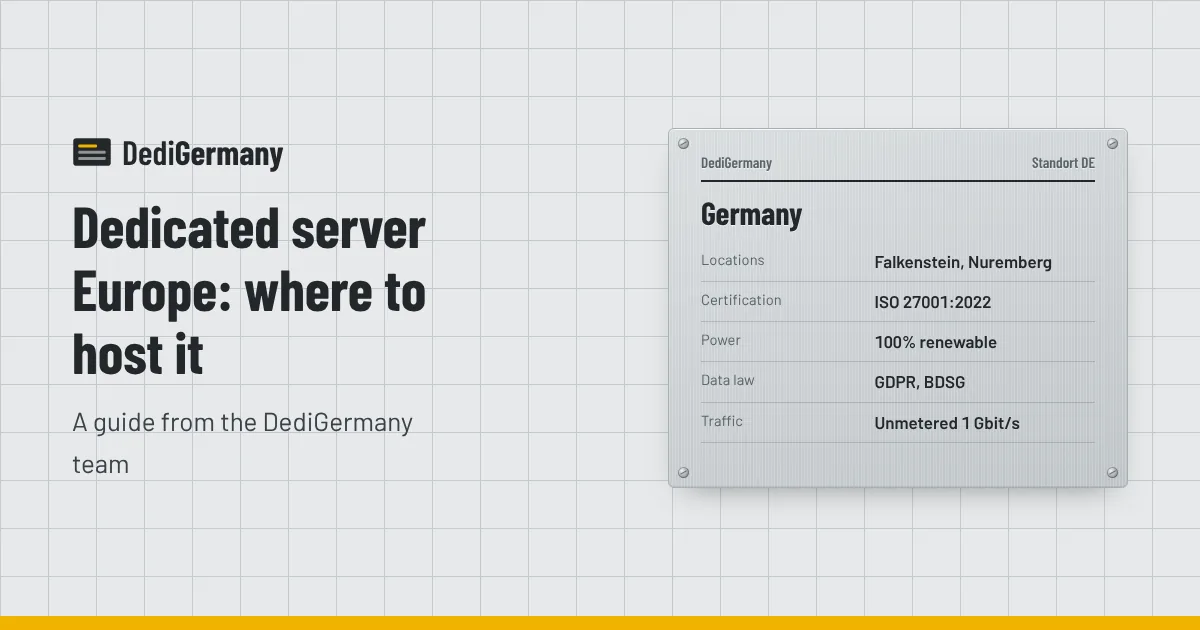
Germany sits in the middle of the continent, and Frankfurt hosts one of the largest internet exchanges in the world. For an audience spread across the EU, a German server keeps the worst-case distance to any user reasonably short. That makes it a sensible default for SaaS products, agencies serving clients in several countries, and hosting resellers whose customers could be anywhere in Europe.
Germany also has a large, competitive datacenter market, which keeps rental prices low by Western European standards. Our own servers are in datacenters in Falkenstein and Nuremberg; the datacenter page explains the facilities, which are ISO 27001:2022 certified and run on 100% renewable electricity. For the legal angle, see why host in Germany.
The other four locations
Netherlands and France: Western Europe
The Netherlands is one of the most interconnected places on the continent, which is why so much content delivery infrastructure lives there. If your users are concentrated in the Benelux countries, the UK or Western Germany, it is an excellent location. The trade-off is that demand is high, and the market reflects that.
France offers good routes towards Spain, Portugal, Italy and North Africa. If a large share of your audience is in Southern Europe, a French server can shorten their path compared with one further north or east.
Finland: cool climate, Nordic reach
Finland's cold climate makes datacenter cooling easier, which matters most for hardware that draws a lot of power, such as GPU servers. Several of ours, including the RTX PRO 6000 GPU server, are hosted in Helsinki. Finland is an EU member, so GDPR applies exactly as it does in Germany.
For interactive web traffic aimed at Southern or Western Europe, Finland is further away. For batch work such as AI inference behind an API, model training or rendering, a slightly longer round trip rarely matters. Our guide to GPU servers for AI discusses the Finland versus Germany choice for GPU workloads.
United Kingdom: a separate legal regime
A UK server makes sense if most of your users are in the UK, or if you need strong transatlantic connectivity. Since Brexit, though, the UK operates under UK GDPR rather than the EU regulation. The two are closely aligned, but they are separate frameworks, so a business that serves EU residents should check how transfers between the UK and the EU are handled for its situation. If you want to keep everything inside the EU with no extra analysis, an EU country is the simpler choice.
Price, power and sustainability
Server rental prices across these five countries are broadly comparable, but local factors push them in different directions. Electricity is one of the largest running costs of any datacenter, so local energy prices and the share of renewable generation matter. A colder climate reduces the energy spent on cooling, which is one reason Nordic countries attract power-dense hardware. Large, competitive markets such as Germany tend to keep monthly prices for mainstream dedicated servers low.
When you compare offers between countries, look past the headline price. Check whether bandwidth is metered, whether DDoS protection costs extra, what additional IPv4 addresses cost and whether a long contract is required. A server that looks cheaper in one country can cost more once traffic overage or a 12-month commitment is included. Our servers are billed monthly in USD with no minimum term, with an unmetered 1 Gbit/s port included.
How to choose for your workload
- Map your users. Look at your analytics by country. If more than half are in one region, host close to it.
- Check your obligations. If contracts or regulators require EU data residency, rule out non-EU locations early.
- Test real latency. Ping a test IP from a few user locations before committing.
- Compare total cost. Include bandwidth, IP addresses and licences, not just the base price. Our post on cheap dedicated servers in Germany lists the hidden costs to check.
- Think about the hardware. CPU servers are fine anywhere; power-hungry GPU servers often favour cooler climates.
For a typical pan-European web application, a server such as the Ryzen 7 PRO 8700GE in Falkenstein with an unmetered 1 Gbit/s port and DDoS protection covers most needs. For latency-sensitive gaming communities across Europe, see our game server hosting in Germany page.
If central Europe suits your audience, browse our dedicated servers in Germany and Finland, or ask us which location fits your users best.