Server auction vs new dedicated server
The choice of server auction vs new dedicated server is a trade between price and predictability. Our server auction lists refurbished machines with no setup fee, often at a lower monthly price for the hardware you get. New plans give you current-generation CPUs, a known configuration you can order again next month and, on several models, ECC memory and datacenter NVMe. This article explains how the two differ and which workloads suit each.
What the server auction is
The auction is a separate list of refurbished dedicated servers, sold alongside our regular plans. A few things define it:
- Refurbished hardware. These are previously used machines, often from earlier CPU generations.
- No setup fee. You pay the monthly price and nothing up front.
- Constantly changing list. The auction refreshes every 15 minutes, so what you see now may be gone this afternoon, and a better match may appear tomorrow.
- Fixed stock. Each listing is a specific machine. If you want a second identical server later, there may not be one.
Billing is monthly with no minimum term, as with the rest of our range.
What new plans give you
Our regular plans are standard configurations you can order at any time. A few examples from the lower and middle of the range:
| Plan | CPU | Memory | Storage | Price |
|---|---|---|---|---|
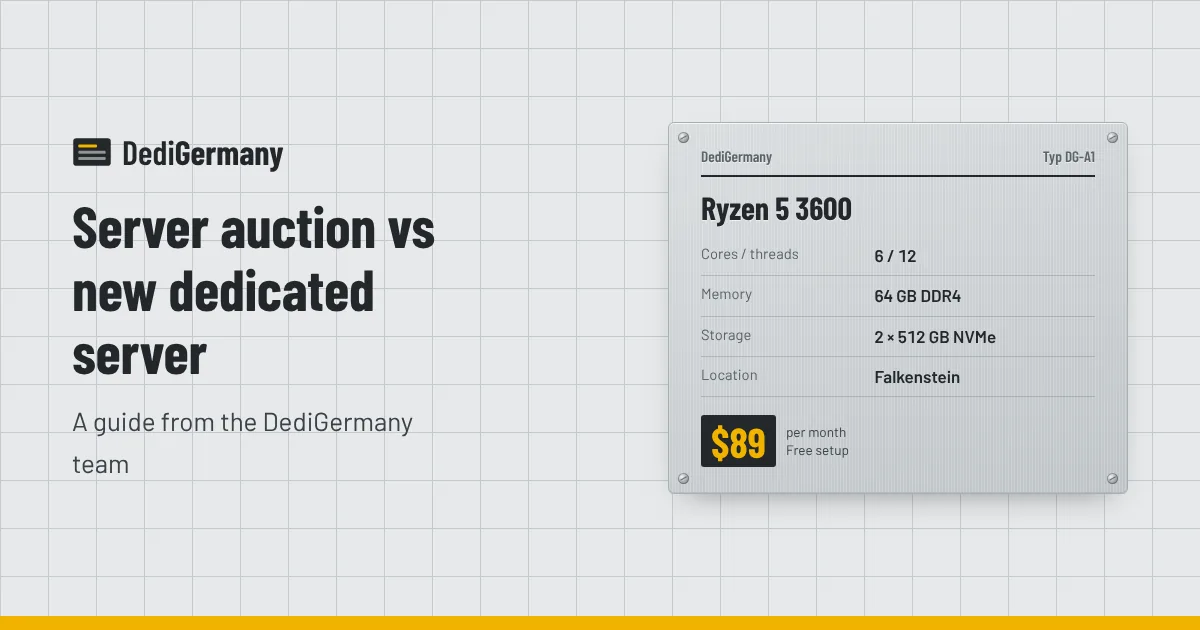
| Ryzen 5 3600 | 6c/12t, up to 4.2 GHz | 64 GB DDR4 | 2 × 512 GB NVMe | $89/mo, setup $0 |
| Core i5-13500 | 14c/20t, up to 4.8 GHz | 64 GB DDR4 | 2 × 512 GB NVMe | $89/mo, setup $0 |
| Ryzen 7 PRO 8700GE | 8c/16t, up to 5.1 GHz | 64 GB DDR5 ECC | 2 × 512 GB NVMe | $149/mo, setup $59 |
| Core Ultra 7 265 | 20c/20t, up to 5.3 GHz | 64 GB DDR5 ECC (max 192 GB) | 2 × 1 TB NVMe | $229/mo, setup $89 |
Every regular plan includes an unmetered 1 Gbit/s port, DDoS protection, 1 IPv4 and a /64 IPv6, NVMe storage in RAID 1, full root or admin access and a rescue system. Most servers are online within 24 hours. Many plans can be upgraded, and hardware upgrades are quoted on request.
Price: where the auction wins and where it doesn't
The auction's main advantage is cost, and it shows in two ways.
No setup fee
Our two entry plans already have no setup fee, so at the $89 level this makes no difference. Higher up it adds up: $59 on the Ryzen 7 PRO 8700GE, $89 on the Core Ultra 7 265 and $159 on the Ryzen 9 7950X3D. If you need a server for a short project of one or two months, skipping a setup fee changes the total noticeably.
Older hardware, priced accordingly
Auction machines are often earlier generations, which is why they can be priced below new equipment with similar core counts or memory. A refurbished server with lots of RAM or several drives can be good value if your workload cares about capacity more than per-core speed.
Where the auction does not win: if a listing costs about the same as one of our $89 plans, the new plan usually gives you a more modern CPU and NVMe storage for the same money. Compare carefully before assuming the auction is cheaper.
Specs and hardware: what to check in a listing
Because every auction server is different, read each listing as you would a spec sheet:
- CPU generation. An older 8-core chip can be noticeably slower per core than a current 6-core one. For game servers and single-threaded applications, clock speed and generation matter more than core count.
- Memory type and ECC. Check whether the listing has ECC memory if you plan to run databases or virtual machines. See ECC vs non-ECC memory for why it matters.
- Storage type. Older servers may use SATA SSDs or hard drives rather than NVMe. That is fine for bulk storage and backups but slower for databases.
- Drive count and layout. More drives give you more layout choices; our RAID and ZFS comparison explains the options.
- Location, network and IPs. Confirm what the listing says about port speed and included addresses.
If anything in a listing is unclear, ask us through the contact page before ordering.
Fixed stock and why it matters
Predictability is the hidden cost of the auction. A new plan is a repeatable building block: if you run three Core i5-13500 game servers and need a fourth, you order the same model and your configuration scripts work unchanged. With the auction, the identical machine may never come back.
That matters for:
- Clusters and scale-out setups, where mismatched nodes complicate capacity planning.
- Resellers and agencies who sell a standard product to their own customers. A consistent base helps; see our reseller hosting server page.
- Licensed software priced per core, where an unusual core count changes your licence bill.
It matters much less for one-off machines: a backup target, a staging server, a personal lab or a single build runner.
Server auction vs new dedicated server: when to choose each
| Choose the auction when | Choose a new plan when |
|---|---|
| The project is short and setup fees would be a large share of the cost | The server will run for a long time and you want current hardware |
| You need capacity (RAM, drives) more than per-core speed | You need high single-thread speed for games or latency-sensitive apps |
| It is a one-off: lab, staging, backup target, batch jobs | You need identical machines now or later |
| You are flexible on exact specs and can wait for the right listing | You need a specific configuration today |
| Budget is the main constraint | You want ECC and datacenter NVMe on a known platform |
A common pattern is to mix both: production on new plans, and auction machines for backups, development and overflow capacity. Because billing is monthly with no minimum term, trying an auction server for a project carries little risk.
If you are still deciding what level of hardware you need, our guide to a cheap dedicated server in Germany and the dedicated server vs VPS comparison are good next reads. Otherwise, check today's listings on the server auction and compare them with our regular dedicated server plans.